
Rehoboth, as we know it, has been in existence for 150 of America’s 250 years. The town has played its part in the country’s history, evolving and growing to meet the changing times. From its earliest days, Rehoboth’s reputation as the nation’s summer capital has been well deserved.
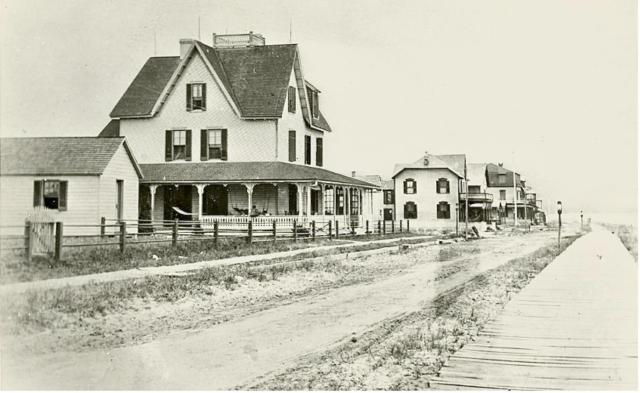
As the town drew attention and gained prominence, it developed and expanded; in part due to the natural draw to its rare location, high elevation, proximity to the Atlantic, and saltwater bay. Also, in part to a handful of visionaries who saw great potential in the unique environment and natural beauty of the geographic area. Henlopen Avenue attracted the largest concentration of Washington DC residents in the early years of Rehoboth Beach, gaining the town the reputation as a coastal retreat. What attracted those early visionaries from cities around the region was the same as what attracts people today… the sound of the waves, the salt air, sea breeze, swimming in the ocean, walking the boards, nightlife, and quiet picturesque streets. They came by train in those early years. Travelers were delivered all the way up Rehoboth Avenue to the depot that was less than one block from the ocean beach. From there, they were delivered to their cottages by horse-drawn wagons. Wealthy families summered in Rehoboth Beach for the full season with the town mostly shutting down in winter.
Many of these summertime residents came to early Rehoboth Beach from Washington DC. However, two prominent DC-based citizens were particularly notable in the development of Rehoboth Beach. A third resident, local to the coastal area contributed greatly to the draw, desirability, and development as well.
These three men are William H. Shock, Robert Cutler Hinckley, and Jack E. Lingo.
William H. Shock
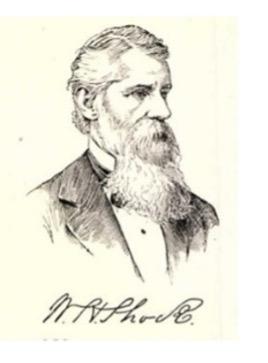
Commodore William H. Shock’s first view of the Rehoboth area came while he was on a survey vessel off the Delaware coast during the 1840s. He would have seen nothing more than two farmhouses; that of Peter Marsh, now the Rehoboth Art League’s historic homestead in Henlopen Acres, and the farm of Lorenzo Dow Martin. Martin’s ‘Triangle Farm’ would be purchased by the Methodist Episcopalian’s in 1873 and eventually become what is the commercial core of Rehoboth Beach town today.
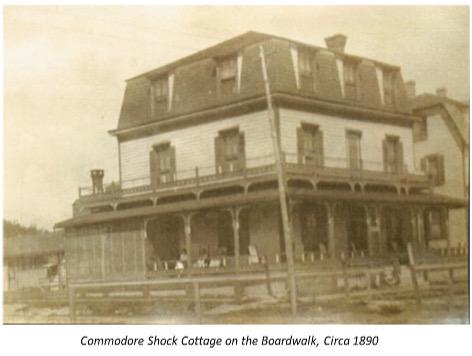
Commodore Shock was a prominent steam engineer for the US Navy and built the steam systems for the ironside vessel, ‘the Monitor’ which won a prominent civil war battle. His engineering transitioned our US Navy from a sailing navy to a steamship navy. Commodor Shock built his distinctive, mansard roofed “cottage” oceanfront in Rehoboth Beach around 1880. By that time, he was retired from the Navy and utilized his Rehoboth home for relaxation. At the time he frequented his shore house, the journey was a day-long trek; involving a trolley ride from DC, a train ride to Baltimore, a ferry ride across the Chesapeake, a train from Kent Island, eventually through Lewes to Rehoboth. It was a trip he would take many times alongside family and friends until the mid- 1900s.
Shock served as a highly respected commissioner of the town for over eleven years, dealing with such issues as controlling domesticated animals, protecting residents from the sins of vaudeville theater, as well as hiring the town lamplighter. The Commodore was one of seven wealthy residents of Rehoboth Beach that took controlling governance of the town form the Methodist Church Camp in 1891.
Robert Cutler Hinkley
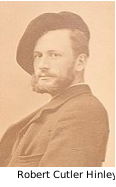
Another prominent Washingtonian, Robert Cutler Hinkley, was a highly respected portrait artist with a studio in Washington, DC. Hinkley was born in 1853 in Massachusetts. As a teenager, he studied art in Paris, where he trained with other ultimately famous American artists, John Singer Sargent and Mary Cassatt. Having already established himself, Hinkley returned from Paris in the early 1880’s, opening a portrait studio in Washington, DC. Like many aristocrats of the era, he summered in Rehoboth Beach.
In 1911, Hinkley purchased the oceanfront, ‘Casino Hotel’ on the south side of Rehoboth Avenue at the boardwalk to transform it into a luxurious retreat. Hinckley thought the auction price was just too good to pass up, immediately renovating the structure and renaming it ‘the Belhaven’. He displayed portraits he had painted of Scottish nobility, Lady and Lord Belhaven, in the lobby of the namesake hotel. Although Hinkley sold the property in 1920, the Belhaven would be in existence until the storm of 1962, when the structure was partially swept into the sea, and his two beautiful portraits were lost to the rising tide forever…
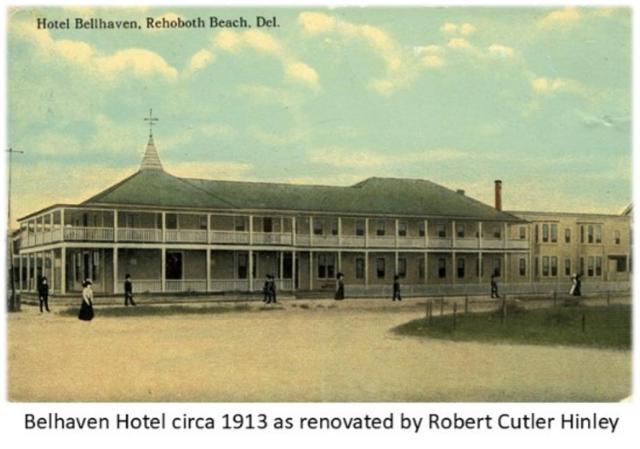
Another of Hinkley’s real estate investments in Rehoboth Beach were portions of family farms belonging to the Dodd family and the Thompson family. That land would ultimately be developed as Rehoboth Heights and annexed into the city in 1927 as what is now ‘South Rehoboth’.
Interestingly, the two families were ultimately connected by the marriage of Mary Elizabeth Dodd and William P Thompson, who are the great-great-grandparents of the current Lingo brothers today. Hinkley is the likely artist of their portraits, now proudly positioned in Bryce Lingo’s formal dining room.
Jack E. Lingo
Washington, DC’s relationship with Rehoboth Beach is not one-sided. Rehoboth Beach has given back to our Nation, sharing its native residents to support our country’s hours of need. Many of Rehoboth’s youth saw action during World War II and beyond. The boys who grew up in Rehoboth and returned to active lives here in the town brought back integrity, resilience, and national pride.
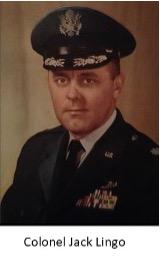
One of these local hero’s is Colonel Jack E. Lingo, the great-grandson of Mary Elizabeth Dodd and William Paynter Thompson. He had entered the University of Delaware when World War II broke out, and left the university to join the Air Force at the beginning of the conflict. Lingo trained to fly B19 bombers and was commissioned a 2nd lieutenant in 1943. He was transferred to the Mariana Islands to serve in the Pacific theater of operations, participating in bombing runs over Japan prior to his honorable discharge. Colonel Lingo was re-enlisted to fly C119’s in the Korean War, where he participated in the Inchon Invasion and the Battle of Chosin Reservoir. After piloting B47’s, Jack was promoted to Squadron Commander of B52’s before completing his 26-year career in the Air Force.
Jack returned to Rehoboth Beach and joining the Anderson-Stokes Realty company helping to develop North Shores, an area along the coast just outside the Town of Rehoboth Beach, which has now become desirable prime real estate. In 1974, Mr. Lingo founded Jack Lingo REALTOR® the Real Estate Brokerage, which still operates today. Over fifty years and three generations later, Jack Lingo REALTOR® is dominant in the coastal Delaware region and very well known amongst buyers, sellers and vacationers as a destination boutique brokerage. Many of those clients selling, searching to purchase, and renting in Rehoboth Beach are from our Nation’s Capital and the surrounding area. Similar to the forefathers that contributed to the development and evolution of Rehoboth Beach, they are drawn by the sea, the air, the boards, and the entertainment.
Visit our Nations Summer Capital to experience the charm and natural beauty of Rehoboth Beach for yourself.
Written by: Paul Lovett, local historian - Rehoboth Beach Museum in partnership with Zane Jones of Jack Lingo REALTOR®


